We will periodically add material to this section. If you have any queries, please get in touch. We have divided the workshops into ‘Nonviolence and nonviolent action’ and ‘Group work and dynamics’ although a number of items could be placed in either category. Plus there are some other resources listed at the end.
If you’re wondering where to start, or would like a quick ‘tour’ of the materials, read our ‘Short guide to training materials from INNATE’. See also the training map, listed at the bottom of this section.
Click on the individual red title below to download any item –
1. Nonviolence and nonviolent action
A simple exercise exploring conflict, negativity and positivity
 A road forward: Dealing with interpersonal conflict without mediation
You can’t get the other party/parties to engage in a process of mediation, or you don’t wish to do so; what are your options? Worksheet and introduction
Re: Conciliation: Working as a conciliator on a conflict
Guidelines for involvement in a situation where, as a conciliator, there are many possible approaches and possibilities and less parameters than in mediation
Notes for a possible workshop on ecological action/eco-nonviolence
Your different options. Worksheet
Getting you message across in public is important; a check list of things to think about in organising a demonstration, vigil or other public event
Exploring divisions in the Northern Ireland context. Can be adapted for elsewhere and other conflicts of different kinds.
Big Boys, Big Girls: Men and violence, women and violence
Exploring gender, violence and nonviolence. Includes an exercise and questions for discussion.
Exploring violence and nonviolence
A couple of fun (physical) exercises exploring violence and nonviolence
Seven controversies in nonviolent action
Controversies with no immediately visible ‘right’ or ‘wrong’ answers. Worksheet. Compiled by Sheila Rose and Lynne Shivers.
A written introduction to different aspects of nonviolence which can be used for background reading and/or discussion.
Nonviolence in Ireland: A study guide
A study guide for personal or group use including many historical aspects. Produced 2020.
Exploring moral, partisan, neutral and tactical/pragmatic bases of nonviolence.
Nonviolence and Christian Belief
A worksheet and facilitator’s notes on this topic.
A short exploration of some of the terms associated with the concept
INNATE’s most used workshop, this explores the broad range of historical examples of nonviolence before doing a risk list (personaising what people feel they can or could do with support) before brainstorming on the campaiging issue concerned.
What is violence? What is nonviolence? Where should we place ourselves in relation to nonviolence?
A brief look at the stages successful social and political movements go through using Bill Moyer’s ‘Movement Action Plan’ (more on it if you word search); includes handout and facilitator notes.
While engaging in mediation can be a lengthy and difficult process it certainly beats an all out fight and resorting to the law. However one or more parties in a dispute may be afraid of mediation for any number of reasons – this handout looks at possible arguments in favour.
2. Group work and dynamics
There is a considerable amount of material on consensus in ‘Consensus for small groups’ (below). But there are many other aspects of group work and dynamics which are important in building effective groups, and, as importantly, not disenchanting those who are already interested and involved. While these may seem at times to be at one move from ‘active nonviolence’ they are actually key to practising what we preach; respect and care for all, including in our everyday working and voluntary lives and commitments and with our ‘own’ people.
Who are our heroes and heroines – personally and in our culture – and what does this say about us?
Gender and Violence – “En-gendering violence”
Exploring the gender role in violence including a possible workshop format
Getting to grips with our own prejudice and deep feelings – facilitator notes
Getting the most from the meeting and workshop experience
Some points in an overview for consideration
Notes on using drama to explore issues
Some info based on Saul Alinsky’s approach
Doing it in the most creative way
Negative group roles taken from Anne Hope and Sally Timmel
‘Had A Good Day At The Office, Darling?’
One-to-one role play on conflict in an organisation/workplace
Handout and facilitator notes for features of mature group process in non-hierarchical voluntary groups/NGOs – with relevance for others too
A short manual, handouts and facilitator notes for exploring consensus in groups
A sample role play scenario and roles to help you develop your own to practise using consensus tools (using the Tools for consensus handout from ‘Consensus for small groups‘ immediately above)
A short game exploring power and privilege
A one page handout with links
Journeys in Nonviolence Training
Some of the options for training and exploration plus their inter-relatedness with other options and areas are explored in this flow chart. (Complied from experience of INNATE).
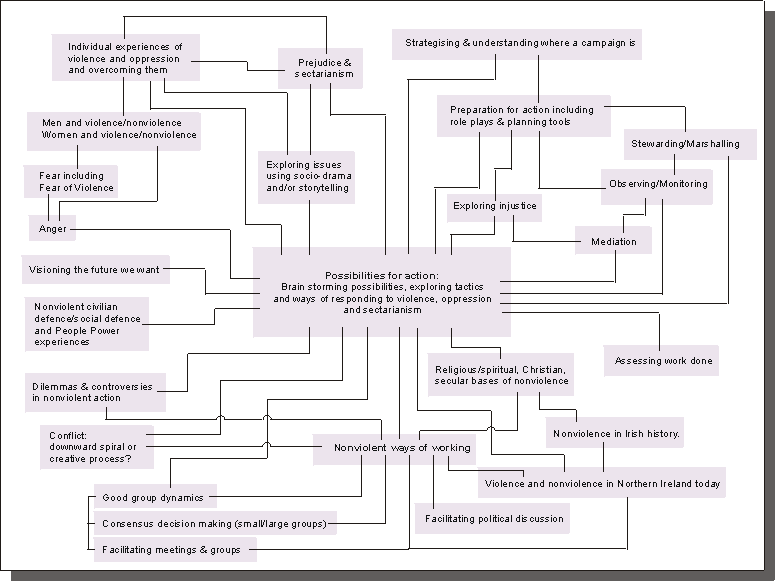
– – – – – –
Manuals and material of value from elsewhere include –
Manual on nonviolent campaigning from WRI
The very useful and relatively comprehensive second edition of the “Handbook for Nonviolent Campaigns” published by War Resisters’ International (WRI) in 2014 had a layout makeover in 2025 and is available for downloading at https://wri-irg.org/en/node/42811 where you can also find the link for ordering a paper copy (UK£12 though UK postage will add to this, particularly outside of the UK postage area). This is the only available, comprehensive manual of its kind that INNATE knows about (it is 233 pages.)
Skills for ‘divided society’ and conflict working
“Dialogue in Divided Societies: Skills for Working with Groups in Conflict” is a revised, 2019, edition of ‘Community Conflict Skills’ worked on by both Mari Fitzduff and Sue Williams with an international civil society audience in mind (building on the original which was framed for Northern ireland), and including both international contexts and more theory.
It is available free online at https://www.centrepeaceconflictstudies.org/publications/browse/ (search ‘williams fitzduff’ to locate it when in that site) and in print from Amazon at https://tinyurl.com/nhbak74d
Monitoring/Observing/Accompaniment/Unarmed civilian protection
See introduction in INNATE photo file which lists many different resources https://www.flickr.com/photos/innateireland/albums/72157629555375796/ Scroll down text at start of album to read it (“Read more”).
The entries temselves also contain some written materals including https://www.flickr.com/photos/innateireland/25987023457/in/album-72157629555375796 whch is a checklist for the features of different kinds of monitoring.
Nonviolent communication
Most associated with Marshall Rosenberg, there is a significant amount of material online if you word search. As a certain proportion of this is basically assertiveness with a nonviolence slant you can also seek out material on assertiveness.