Tag Archives: Ireland

Archival, documentary and campaigning materials available from INNATE

The two INNATE websites https://innatenonviolence.org/ (the ‘main’ INNATE website) and https://www.flickr.com/photos/innateireland (the INNATE photo and documentation site) have a substantial amount of material available on a broad understanding of peace, nonviolence and related matters. The following listing can only be considered partial but it is indicative of the contents; it is listed alphabetically in relation to each site.

As always, INNATE is happy to consider additions to its online material. Please contact innate@ntlworld.com This information also appears at https://innatenonviolence.org/wp/wp-content/uploads/2023/01/INNATE-online-listing-2023-for-web.pdf

INNATE photo and documentation site

https://www.flickr.com/photos/innateireland

With a total of nearly two and a half thousand entries (as of January 2023), finding what you might want, or be most interested in, can be difficult so it is recommended that most users go to the ‘Albums’ (groupings of photos/entries on a theme). Below is a listing of the albums and their main content, however when clicking on ‘Albums’ online they are not listed alphabetically so you will need to scroll down to the ones you want. Some albums are very limited but photos are grouped this way to make them more accessible. Album can overlap, i.e. one entry can appear in a couple, or more, albums.

You can also use the word search facility in the top menu bar and this is useful where there is no obvious album to search or you are looking for a specific person or organisation not featured as an album. Where possible website links are given. Information about use of the material featured appears on the site (under ‘About’ on the top menu bar)

lAfri – Nearly two hundred photos from Afri events and famine walks over the years.

lAnti-Nuclear power movement – Mainly photos and documentation from late 1970s but also photo essay on wind turbines at site of erstwhile nuclear plant at Carnsore Point.

lAVP/Alternatives to Violence Project – Mainly from the international conference in Ireland,2014, but also on work in Bolivia and India.

lBishopscourt Peace Camp, 1983-86 – Photos and documentation from this peace camp at Bishopscourt RAF base, Co Down.

lChurches Peace Education Programme (1978-2005) – A small number of photos and documents on this important resource.

lCND and nuclear disarmament – Mainly 1980s photos and documentation, also Faslane in the ‘noughties.

lConflict Textiles – Comprehensively documented on its own website, this is a selection of photos from Conflict Textile events and exhibitions.

lCorrib Gas, 2011 – A short photo essay on ‘security’, monitoring and resistance at the Co Mayo site.

lCOP 26, Glasgow, 2021, a photo essay by Larry Speight.

lCorrymeela Community – A selection of photos of people and events, and documents from over the years.

lDawn (1974-85) – Scenes from producing Dawn magazine, events, and documentation.

lDealing with the past – A small selection of photos, on Northern Ireland and some international.

lDisarmament and resistance to war – A broad sweep of photos and documents from around Ireland.

lDrumcree Faith and Justice Group, Portadown – A small selection of photos and material from this important local group in the 1980s-1990s.

lEcology and green resistance – A limited but fascinating selection from actions and events.

lFellowship of Reconciliation – Photos from some International FOR events and some documentation on Irish/Northern Irish FOR (1949-1998)

lG8, Fermanagh, 2013 – Photos from Belfast and Fermanagh alternative events/demonstrations.

lGender and peace – A selection of photos on this frequent elephant in the room.

lGlencree Centre for Reconciliation – Documents from around the start in 1974 plus photos from the 1980s and recently.

lHuman rights – A small selection of photos mainly from Northern Ireland.

lHumour and satire – A miscellany showing the lighter side of entries on the site….

lInclusive and consensus decision making – A small selection with essential links.

lINNATE history – A selection of photos and entries on INNATE’s events and history since 1987.

lINNATE seminars and conferences – Photos of participants and documentation.

lIrish neutrality – A broad selection of photos and documentary entries.

lIrish Pacifist Movement (1936-1969) – Documentation and history.

lJustice Not Terror Coalition, Belfast, 2001+ – Opposition to the ‘war on terror’, post-9/11.

lKilcranny House, Coleraine (1985-2012) – Photos from this ecologically-focused peace centre.

lMediation – Some important photos and documentation from the start of focused mediation in Ireland in the mid-1980s, including MNI/Mediation Northern Ireland and MII/Mediators’ Institute of Ireland.

lMen, gender and nonviolence – Photos from international trainings for men by the Women Peacemakers Program (WPP), 2009-10

lMonitoring and accompaniment – A wide range of photos and links to informative material (see the information at the top of the album)

lMuseums for Peace, Belfast, 2017 – People and events from their 25th anniversary conference.

lNonviolence training – Photo from training events at home and abroad.

lNorthern Ireland Peace Forum (1974-88) – Documentation.

lNorthern Ireland, Troubles and Peace in – Several hundred photos and documents mainly from and about the peace and reconciliation movement, and also the general situation.

lNorthern Ireland peace process – A small selection of newspaper items, 1994-2007.

lPax Christi – Documentation and a few photos, mainly 1970s-1990s.

lPeace and Reconciliation Group (PRG), Derry, (1976-2015) – A small number of photos and documents.

lPeace miscellany, 2009-10 – A small number of photos from this time.

lPeace People – Photos from 1986 and documentary material from the beginning in 1976.

lPeace trails – A small but informative selection on peace trails, including Belfast and Mayo.

lQuaker peace work and witness – A limited number of photos on primarily Irish Quaker peace work.

lRaytheon Derry campaign, 1999-2010 – A wide range of photos from the succesful campaign to get arms company Raytheon out of Derry.

lSean MacBride – A small number of writings or interviews, taken from peace movement sources from the1980s, and one Afri event photo.

lThales arms company – Photos of demonstrations at the Castlereagh, Belfast plant.

lTom Weld artwork – Some examples of his map like work on peace and human rights.

lTrade Union/ICTU NIC action for peace – In relation to Northern Ireland and abroad.

lUS/NATO military bases, conference against, Dublin 2018 – People and events.

lWar Resisters’ International – Mainly from the Dublin 2002 international conference.

lWitness for Peace (1972+) – A small number of documents and cuttings.

lWomen Together (1970-2001) – Mainly documentation but also some photos.

lWorld Beyond War international conference, Limerick, 2019 – People and events including a visit to Shannon Warport.

INNATE main website

https://innatenonviolence.org/

Nonviolent News is the main INNATE resource with all issues available since 1990 (it was occasional until 1994 when it became monthly). It went online in 2003 when the email and web edition became longer than the paper edition which became the first two pages of news only (older issues appear as PDFs). It is still produced in email and web editions (with the same content in both) and a shorter paper edition.

The INNATE website changed to WordPress in 2021 but all the previous material is available – you just need to click on the button to the right of the home page to get to the older site. If word searching for something you may need to do it on both the new and the old sites.

Resources are listed alphabetically below, with an indication where necessary of their location.

lAn alternative defence for Ireland (Dawn, 1983)

Perhaps somewhat out of date this still indicates it can be done…. https://innatenonviolence.org/wp/pamphlets/

lBishopscourt Peace Camp 1983-86

A short 4 page broadsheet analysing the history and context of this peace camp. https://innatenonviolence.org/wp/pamphlets/

lChristian Nonviolence – a study pack (1993)

Originally produced by the Fellowship of Reconciliation and Pax Christi, this is a useful introduction to the topic. Nonviolence and other religions have been explored in some ‘Readings in Nonviolence’ in Nonviolent News. https://innatenonviolence.org/wp/pamphlets/

lConsensus for small groups

An introduction and worksheets including tools that can be used. https://innatenonviolence.org/workshops/consensussmallgroups.shtml See also https://www.flickr.com/photos/innateireland/52550857618/in/dateposted/

lCorrymeela House Belfast

A short history of/tribute to Corrymeela House in Belfast which closed in 2014. https://innatenonviolence.org/readings/2014_11.shtml

lDawn Train

PDF copies of all 11 issues are online with contents listing at https://innatenonviolence.org/dawntrain/index.shtml This includes material on facilitating political discussion (Sue and Steve Williams, DT No.11), what enabled people in the North to change their views (Mari Fitzduff, DT10), and much more about peace and nonviolence at home and abroad.

lEco echoes

A compilation of some of Larry Speight’s columns from Nonviolent News married with his keen eye photography. https://innatenonviolence.org/wp/pamphlets/

lMichael Davitt, Land War and Non-violence

An 8-page pamphlet from Dawn (1979) exploring this important person and topic. https://innatenonviolence.org/wp/pamphlets/

lINNATE annual reports

All you never wanted to know about INNATE with a page per year. https://innatenonviolence.org/wp/annual-reports/

lMusical musings on Irish history and culture (2002+)

An exploration of violence, nonviolence and social change in Ireland through music and ballad, by Rob Fairmichael. https://innatenonviolence.org/resources/musical.shtml

lNonviolence – The Irish Experience Quiz

A fun way to challenge our perceptions of Ireland over the centuries – with questions on one side and answers on the other. Link at https://innatenonviolence.org/wp/resources/

lNonviolence in Ireland – a study guide

This can be used for individual or group study with links to material and questions for thought or discussion. Link at https://innatenonviolence.org/wp/resources/

lNonviolence – An introduction

What it says on the tin – an introduction to nonviolence from INNATE

https://innatenonviolence.org/resources/intro/index.shtml

lNonviolence Manifesto from INNATE

Short and to the point in 2 sides of A5. Link at https://innatenonviolence.org/wp/resources/

lNonviolent News since 1990

– News section – monthly news, all issues since 1990 online, covering a wide range of peace, nonviolence, green and human rights news and initiatives from around Ireland, with links where possible.

– Editorials – Commentary on current issues at home and abroad.

– Eco-Awareness – Larry Speight’s incisive commentary on green issues since 2004.

– Readings in Nonviolence – Reviews and material of many different aspects.

– Billy King:Rites Again – Idiosyncratic commentary on the world, the flesh and the divil else.

Each of these sections can be accessed independently or within the relevant full issue.

https://innatenonviolence.org/wp/category/nonviolent-news/ and pre-2021 issues at https://innatenonviolence.org/news/index.shtml

lNonviolence in Irish History

Dawn magazine’s pamphlet from 1978 still has important information and a wider message challenging the view of Irish history only being about violence. https://innatenonviolence.org/wp/pamphlets/

lMy kind of nonviolence (2012)

Fifteen people from around the island give their view on what nonviolence is about – a direction is perhaps evident, but no party line. https://innatenonviolence.org/wp/pamphlets/

lThe nuclear syndrome – Victory for the Irish anti-nuclear power movement

An extract from Simon Dalby’s thesis on this significant late-1970s movement looks at questions of organisation and strategy. https://innatenonviolence.org/wp/pamphlets/

lPeace groups in Ireland through the years

An up to date listing first issued in 2022 giving a very brief profile and links or suggestions for further information. Link at https://innatenonviolence.org/wp/pamphlets/

lThe Peace People Experience, 1987

An in depth study looking at the overall story after a decade of the Peace People, where the money went, the story of local groups, and interviews with key personnel. https://innatenonviolence.org/wp/pamphlets/

lPeace trails

Links for at home and abroad in a couple of newsletters on peace trails. https://innatenonviolence.org/wp/peace-trails/

lPosters

Designed for home printing, there are well over a hundred small/A4 size posters which cover a multitude of issues in the fields of peace, nonviolence, violence, green issues, human rights and justice. https://innatenonviolence.org/wp/posters/

lWorkshops/Training in nonviolence, and group work and dynamics

A wide range of material for workshop use – which can also be used for personal study – including one on nonviolent tactics to use in relation to a campaign, the stages a successful movement may go through (‘Workshop on strategising’), and gender and violence.

https://innatenonviolence.org/wp/workshops/

lVegetarian and vegan cuisine

A short guide for those looking for new ideas for food in this area of importance to countering global warming. https://innatenonviolence.org/wp/pamphlets/

Materials passed to PRONI

INNATE has passed older archival material to the Public Record Office for Northern Ireland (PRONI) which is based in the Titanic Quarter in Belfast. The volume would be equivalent to about 7 boxes of material of 45 x 35 x 30 cm. A small amount of this material appears digitally in the INNATE photo and documentation site on Flickr https://www.flickr.com/photos/innateireland

Since it requires attendance at PRONI to access this material no comprehensive listing is given here but a full list of material passed to PRONI is available on request to innate@ntlworld.com What follows is a brief indication of its contents. The PRONI reference numbers for the material are D4828 (deposited 2021) and PTE 83/2022 (for additional material deposited in 2022). It includes Northern Ireland ‘peace and reconciliation’ material as well as internationally-related peace material from both sides of the border in Ireland

D4828

Includes dated peace movement ephemera (leaflets, cuttings, papers etc) from 1970s to 2018 and a wide variety of specific files and some photos.

PTE 83/2022

Includes more Dawn and INNATE materials and extensive materials on the Peace People used in the preparation of ‘The Peace People Experience’ pamphlet (1987).
Nonviolent News supplement, January 2023

SUPPLEMENT to Number 305, Belfast 6th January 2023

Please note this is a short supplement with mainly time-limited or immediate information, not a full issue.

Louie Bennett memorial event, Dublin

On Saturday 7th January, at 2 pm, Afri will lay a bouquet of flowers at the bench in St Stephen’s Green commemorating Louie Bennett (1870-1956) . ‘As we emerge from the Decade of Commemorations,’ said Professor John Maguire of Afri, ‘it would be difficult to find any other person who so vividly embodies the complex strands of our heritage, or the challenges of creatively reworking that heritage in today’s fraught world.’ Louie Bennett had a long and distinguished record of activism, for women’s right to vote, in opposition to war and militrism, and for the rights and welfare of women workers (she was the first woman to be president of the ICTU, a position she held twice). As Afri mention in their announcement, the memorial bench in St Stephen’s Green is curved, reflecting her belief in encouraging conversation. www.afri.ie

Afri Féile Bríde; Darkness Dawning Light

The 30th Féile Bríde will be on Saturday 4th February when those speaking/performing will include Emer Lynam, Adi Roche, Tommy Sands, Justine Nantal, and Luka Bloom. As usual/normal it will take place in the Solas Bhríde Centre, Kildare town. Full details and booking information soon on the Afri website at www.afri.ie The event will begin at 10.30am with a Ceremony of Light in the Square in Kildare.

Belfast Military-Industrial complex thrives

Thales in Casttlereagh, Belfast has been given a £223 million contract from the British Ministory of Defence for hand-held anti-tank missiles. Thales will assemble these ‘next generation light anti-tank weapons’ (NLAWS) for Saab. Secretary of State Chris Heaton-Harris expressed his delight at the news and the managing director of Thales in Belfast, Philip McBride said ““Once again, Northern Ireland is demonstrating its significant role in the UK defence enterprise.” Thales employs around 600 people. More details at https://www.bbc.co.uk/news/uk-northern-ireland-64057780 and https://www.belfasttelegraph.co.uk/news/northern-ireland/belfast-weapons-factory-receives-contract-to-produce-anti-tank-missiles-42235861.html

FOE-NI address change

Friends of the Earth in Northern Ireland has moved to a new office; Gordon House, 22-24 Lombard Street, Belfast, BT1 1RD. Otherwise their details remain the same. https://friendsoftheearth.uk/northern-ireland

Tools for Solidarity

Tools For Solidarity is a not-for-profit organisation based in Belfast and the main focus is to support artisans in the poorest parts of the world and mostly in the countries of Africa. This act of solidarity enables them to become more self-reliant and have some hope for the future. You can read up on TfS work and history at https://www.toolsforsolidarity.com/ including their latest, informative, newsletter at https://www.toolsforsolidarity.com/publications/newsletters/

AVP/Alternatives to Violence Project: Annual report, coordinator

AVP have issued their annual report for 2022. 36 prison based volunteers and 22 community based volunteers were involved in the running of 41 workshops in all Irish Prisons except Cloverhill and Arbour Hill. Around 60 courses were assessed and completed this year in Cloverhill and Mountjoy prisons. AVP trained 32 new facilitators (22 prison based and 10 community based volunteers). 22 new community volunteers have taken part in some training and most of them are very close to completing it. Innovations in the year included a 3rd level ‘Female Awareness’ workshop which was piloted twice in the Dóchas. AVP expects to be able to offer up to 500 participations in our training across Irish prisons in 2023, apart from other programme.

The coordinator left her position at the end of the year and AVP is recruiting a new coordinator. The ad for the position will be in LinkedIn and Activelink. In leaving she said “I am extremely grateful to AVPers for the privilege of having worked with you all, these 7 past years, thank you for the meaningful work, the learnings, the laughs, the connections, the deep conversations, the friendship, care and love! May our AVP community keep learning, connecting and growing! Democratic Dorothée”. See also https://avpireland.ie/

Eco Congregation Newsletter

There are 19 pages of news from around the country’s churches in relation to their ecological involvement and other information in the Advent issue of the Eco Congregation Newsletter which can be opened at their website https://www.ecocongregationireland.com/

The next, full, issue of Nonviolent News is for February with a deadline of 1st February

News, December 2022

A force for good?

A force for good? Reflections on neutrality and the future of Irish defence” is a new 62 page pamphlet from Afri, launched in Leinster House at the end of November. It is essential reading for anyone interested in Irish foreign policy and contribution towards peace in the world. The contributions include a preface by Nobel Peace Prize Laureate Mairead Maguire (who also writes another piece on ‘The true cost of violence and war’). The pamphlet’s substantial input includes a detailed account by Karen Devine of Frank Aiken’s legacy and lessons for the conflict in Ukraine. John Maguire contributes an open letter to Lt-General Seán Clancy, Irish Chief of Staff, Tarak Kauff surveys Irish neutrality as a global force for peace, Iain Atack and Carol Fox consider some other important details of the situation, before John Maguire considers the woolly thinking behind the Commission on the Defence Forces report. The pamphlet ends with the Downpatrick Declaration.

This pamphlet clearly analyses the Irish government’s drift to NATO membership and EU militarisation while reflecting on positive policies for peace in the past (Frank Aiken) and considering how Ireland could play a meaningful role in European and world peace in the future. Paper copies are available from Afri at €10 including postage at https://www.afri.ie/donate/ It will be on the Afri website in due course. Afri , 8 Cabra Road, Dublin D07 T1W2, email admin@afri.ie and website www.afri.ie

Palestine: New Irish Anti-Apartheid Campaign launched

The Irish Anti-Apartheid Campaign for Palestine has called on Ireland and the international community to publicly recognise that the State of Israel is committing the crime of apartheid against the Palestinian people, and to take concrete measures to end this crime against humanity. The coalition, made up of 18 civil society organisations, trade unions and academic experts committed to working collaboratively to end Israeli apartheid against Palestinians, was launched in late November in Dublin by Independent Senator Frances Black, a long-time campaigner for Palestinian rights. Groups involved are: Academics for Palestine, Action Aid Ireland, Afri, Amnesty International Ireland, Centre for Global Education, Comhlámh/Comhlámh Justice for Palestine, Gaza Action Ireland, Global Legal Action Network (GLAN), Ireland-Palestine Solidarity Campaign, Irish Congress of Trade Unions (ICTU), Irish Council for Civil Liberties, Jews for Palestine, Kairos Ireland, Sadaka – the Ireland Palestine Alliance, SIPTU, TCD BDS,Trade Union Friends of Palestine, and Trócaire. See https://www.trocaire.org/news/new-irish-anti-apartheid-campaign-calls-on-ireland-to-take-action-on-israeli-apartheid-against-palestinians/ and web search.

The Steel Shutter revisited: Northern Ireland encounter, 1972

A Belfast conference on 1st December 2022 looked at the encounter group workshop of precisely fifty years previously involving four Belfast Protestants and four Belfast Catholics (including facilitation by ‘the’ Carl Rogers). The 2022 conference was organised by Michael Montgomery of PeaceFire www.peacefire.us and the original one hour ‘Steel Shutter’ film is available on this website. The conference examined numerous aspects of encounter groups and storytelling and their ongoing relevance for conflict situations and divided societies. See also https://www.flickr.com/photos/innateireland/52536717565/in/dateposted/

H&W militarise again

There was a time that Harland and Wolff shipyard in Belfast made British naval ships, possibly the last was HMS Fearless which was completed in 1965. Unfortunately it looks like H&W may be returning to this practice of making ships for the Royal Navy. While it is not a done deal yet, an announcement in mid-November indicated that 3 new British navy supply ships, each 216 metres long, in a £1.6 billion contract may see the final assembly taking place at Harland and Wolff which forms part of a preferred bid by a consortium of three UK firms. If proceeding work may begin in 2025 and of course there will be many jobs created but jobs contributing to ongoing militarisation. Word search online for more information.

Protests in Cork at Dutch navy visit

At the end of November, protests were held by the Irish Neutrality Campaign at visits to Cork by 4 warships from NATO member the Netherlands (including their largest naval ship). See https://www.echolive.ie/corknews/arid-41015759.html and https://tripeanddrisheen.substack.com/p/four-dutch-naval-vessels-dock-in Protesters pointed out that the Netherlands has supported NATO belligerance and the visit was a breach of Irish neutrality. In addition, PANA, www.pana.ie, pointed out that “The recent Fine Gael Ard-Fheis passed a motion effectively to scrap the Triple Lock on sending Irish soldiers on overseas missions, by eliminating the need for a UN mandate for such missions. Rather than equip our forces appropriately for genuine defence and UN-directed peacekeeping, our government seems intent on merging them with EU/NATO ventures such as PESCO, Battlegroups etc.”

Swords to Ploughshares: Human and ecological security

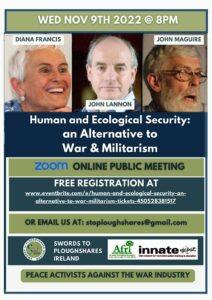
The hour long recording of the StoP/Swords to Ploughshares webinar in early November on “Human and ecological security: an alternative to war and militarism” is at https://www.youtube.com/watch?v=bpcK1QYLk6M Speakers were Diana Francis, John Maguire and John Lannon.

Ukraine war used to justify arms race

In the wake of Russia’s full-scale invasion of Ukraine in February 2022, western governments pledged unprecedented financial support to militarism, citing the threat posed by the war as justification. However, as the research in the report below shows, western states are already vastly superior in terms of military expenditure and defence capacity to other nations. Prior to the war the combined military spending of NATO members was 17 times that of Russia and four times that of China. Increased military spending does nothing, quite the reverse, to deal with issues of world poverty and global warming. This report by he Transnational Institute and Stop Wapenhandel, “Smoke Screen – How states are using the war in Ukraine to drive a new arms race” , is available in summary form and download link at https://www.tni.org/en/publication/smoke-screen

Afri calendars

Having a meaningful calendar around your home or work space may give you a daily lift – and a reminder of appointments. Afri produce a calendar which highlights the importance of all of us getting involved in tackling such pressing issues as climate change and militarisation. To order (at €7 per calendar plus €2.50 postage cost within Ireland) go to www.afri.ie/donate/ and click the donate button at the bottom of the page ‘donating’ the cost of your purchase and indicating the number of calendars you would like to order in the message box; remember to include your postal address. Email admin@afri.ie

WRI Prisoners for Peace

1st December and the period around then is when the War Resisters’ International particularly remembers conscientious objectors and prisoners for peace (their work to support them is all year around however). This year it has a particular focus on Russia and Ukraine – not surprisingly given the numbers imprisoned or facing imprisonment there. See https://wri-irg.org/en/story/2022/2022-prisoners-peace-day and links there.

USA military empire database

World Beyond War have put together an interactive database of USA military bases worldwide. As they say “Some of these physical installations are on land occupied as spoils of war. Most are maintained through collaborations with governments, many of them brutal and oppressive governments benefiting from the bases’ presence. In many cases, human beings were displaced to make room for these military installations, often depriving people of farmland, adding huge amounts of pollution to local water systems and the air, and existing as an unwelcome presence.” See https://worldbeyondwar.org/no-bases/

CGE: Why are INGOs not talking about the global economy?

Material from the Centre for Global Education’s October workshop on why Irish NGOs are not critically engaging with issues of the global economic system, neoliberalism, as the ‘root cause’ of poverty is available at https://oneworldfestivalni.com/events/why-are-ingos-not-talking-about-the-global-economy/

2022 Pax Christi International Peace Award: Concordia

Concordia Social Projects has received the PCI 2022 peace award. The organization is present in several central and eastern European countries, and works directly to help vulnerable and disadvantaged children and their families. See https://paxchristi.net/2022/11/08/2022-pax-christi-international-peace-award-concordia-social-projects/

Chernobyl Children International

Chernobyl Children International/CCI are appealing at this time of year for financial support for their work in Ukraine and Belarus. For full information, and options to donate, see https://www.chernobyl-international.com

Cyber safety for women

Women – and men – may be interested in this very detailed cyber security guide https://www.wizcase.com/blog/comprehensive-online-security-guide-for-women/

Editorial: Neutrality – being the best we can be

Ireland faces a choice as to whether to be a small bit player in a militaristic EU/NATO alliance or to plough a perhaps sometimes lonely but much more fulfilling role as an active agent for peace in the world. But any loneliness would only be temporary because of the friends it would make – as it is, an Irish passport is one of the most acceptable around the world because of Ireland’s past positions and ‘soft power’. Those who think that NATO and the EU are agents bringing peace need to consider the process of 20th and 21st century history – and extrapolate from current EU stances to the EU becoming a bullying superpower on the world stage, similar to the USA, later in the 21st century (just look at the current role of Frontex). The development of the EEC/EU as a force for peace in Europe is well and truly lost in the past.

It is hard to establish exactly where the Irish government and establishment push for full military and foreign policy integration with NATO and the EU comes from. Wanting to be with the ‘big boys’ is certainly part of it. This editorial will, further on, give some quotations from Afri’s new “A force for good?” pamphlet on Irish neutrality. But we would go further and raise the question of whether this fixation stems partly from an inferiority complex, perhaps coming from Ireland’s colonial past. The revolutionary generation in the Free State/Republic had an emphasis, naturally enough, on anti-colonialism and anti-imperialism (Karen Devine’s contribution in the Afri pamphlet is a brilliant summary of the positive aspect of this in Frank Aiken’s thinking and action). But as EEC membership beckoned, neutrality became considered by some politicians as backward, regressive and not what was needed in Ireland – in a sense a ‘culchie’ option – making its way in a world dominated by the USA and a rich Europe.

In the Afri pamphlet, Iain Atack and Carol Fox do refer to the idea that to be ‘good Europeans’* has been part of the thinking in abandoning neutrality (along with other factors). But what does being a ‘good European’ mean? Supporting militarisation and the arms industry? Being uncritical of the development of the EU as a military superpower closely aligned with NATO?

With formerly neutral countries in Europe joining NATO, surely there is a greater need than ever before for Ireland to take a neutral and active stance for peace. It is simply nonsense to think that the only possible international role Ireland can play in the future is a small, even insignificant, member of a large military alliance. The promulgation of Irish neutrality goes back as far as Wolfe Tone. Eamon de Valera played a significant role in the League of Nations. As the Afri pamphlet points out, the drift to Irish EU foreign policy and military integration has led to relative neglect of the UN – and, we might add, perhaps a wasted role as a UN Security Council member. Ireland has played a significant part in the development of peace internationally. Current directions will lead to the total negation of that role and Ireland simply being another cog in a great western militarist machine. It is already happening – for ‘NATO in Ireland’ see https://www.thejournal.ie/irish-defence-forces-nato-evaluation-artillery-5927841-Nov2022/

There are many ways that Ireland can play a positive role in peacemaking in the future, all of which are either dependent on, or would have a contribution made by, Irish neutrality. Building up a skilled team of mediators for different levels of conflict is one such role, engaging before there are even ‘rumours of war’ or armed conflict. Engaging with different parties or governments before conflicts have got ‘hot’ is another related area of work. Pushing and working for the further development of international law in relation to war is a further area – and working to get existing laws implemented and respected. Nonviolent peacekeeping can be explored as well as Ireland’s well-established – and respected – role in military peacekeeping.

This is only scratching at the surface of what is possible, even for a small country like Ireland, and all could be achieved for a small fraction of the additional money which the country is going to spend on army and armaments – which is irrelevant to Ireland’s human and ecological security needs (see the video of the StoP webinar on this, mentioned in the news section). Our politicians and elite seem to suffer from a total failure of imagination and seek no more than being a very small cog in a very well-oiled, and destructive, military machine.

Now, on to a few quotes from Afri’s pamphlet (see news section in this issue). The title of Joe Murray’s Foreword says it all: “Ireland should be a voice for Demilitarisation, De-escalation and Disarmament in the World”. Karen Devine points out that “Ireland used her postcolonial identity and history to gain support from other UN members. A fiercely-guarded commitment to independence from big power pressures, facilitated by an equally strong commitment to neutrality, produced radical and far-reaching proposals for peace in central Europe. Frank Aiken’s formulae for peace are vitally relevant to resolving the Ukrainian situation today……”

Mairead Maguire is quite clear that “Contrary to its claims, NATO is not a defensive organization. Its purpose from the start has been to act as an instrument for US world domination and to prevent all challenges to US hegemony.” John Maguire meanwhile teases out what has been going on in Ireland: “The….strategy involved: Government denials at every stage that referendums were necessary; joining NATO/PNP without the manifesto-promised referendum;’reform’ of the Referendum Commission’s mandate, from presenting the arguments For and Against to magisterially pronouncing on ‘The Facts’ – and above all the blatant rejection of two legally binding referendum results, Nice 1 and Lisbon 1.” John Maguire also usefully uses the image of a funnel: “The abiding image is of a funnel; such debate as cannot be prevented is guided – if necessary, simply shoehorned – into an ever-narrowing channel; a travesty in what our constitution still confirms is a republic.”

In the Afri pamphlet, Tarak Kauff concludes his piece “Stand up Ireland, defend your neutrality. The global community needs you to do that.” Ireland may be a little island falling off the edge of Europe but Tarak Kauffman’s admonition shows that such a matter is of much greater significance. As peacemakers we can stand tall. As warmakers we will collude with, and hide under the coat tails of, the great powers, and contribute to the militarist mania infesting the world.

* INNATE’s printable poster on being ‘a good European’ can be found at https://innatenonviolence.org/wp/posters/ under “Europe and World…[EW]”

Billy King: Rites Again, 305

In the damp of Irish weather you might not always recognise relatively warm weather outside of summer, but the autumn has been just that. In the garden, leaves and foliage have been very slow to die back and perennial plants to take on their winter garb (or lack of it). ‘Our’ lilac – actually in a neighbour’s garden – still has quite a few leaves on it and the new growth which came after it got chopped back in the summer looks perfectly green and healthy. Marigolds and rudbeckia are still flowering away. The gorse/furze/whins/aiteann outside the city looks like it is coming into nearly full bloom. A few decades ago you could have expected a hard frost before the end of October – I define a hard frost as probably something below -2° although in practice I see it as when all the nasturtiums turn to mush. Last winter there was no ‘hard frost’ at all. It’s global warming at work, and in the Irish context that can mean more rain and wind. And you may want to issue a religious or secular prayer that the Gulf Stream doesn’t stop or Newfoundland here we come…..

Reconciliation

Reconciliation is an interesting word and concept, conciliation is too but what does it mean and especially in the context of the North? Rev Norman Hamilton, a former Presbyterian Church in Ireland moderator, recently accused the various governments and politicians of not having a clear definition https://www.newsletter.co.uk/news/politics/ex-presbyterian-moderator-asks-london-dublin-washington-and-ni-politicial-parties-for-their-definition-of-reconciliation-3906790

There are technical definitions of reconciliation in relation to accounting and legislative processes but relevant definitions in this context include “The act of reconciling parties at variance; renewal of friendship after disagreement or enmity” and “the process of two people or groups in a conflict agreeing to make amends or come to a truce” – obviously in the context of the North, however, we are talking about group processes, so “the process of making two people or groups of people friendly again after they have argued seriously or fought and kept apart from each other, or a situation in which this happens” is a bit more apposite (as opposed to opposite). We probably all need to work on our own definitions of reconciliation, and indeed our understanding of forgiveness (another difficult one to be clear about).

I am reminded of the old cartoon about a character expressing thanks for advice they were given about dealing with interpersonal conflict rather than letting it fester. Asked how they resolved the matter they stated, “I killed the bastard”. No, not funny except just possibly in a fictional circumstance of someone doing the unexpected. And doing something positive and unexpected is an excellent way to promote reconciliation. A positive gesture or undertaking can be a great way to assist travelling to reconciliation. Actually listening to each other in the North, as opposed to talking at each other, could be such a gesture.

The U?S of A

There are bodies which proclaim themselves unreformed and unreformable. However realities change over time even if systems do not and the US political system seems singularly inappropriate for the 21st century, likewise the idea that you need a billion dollars, or thereabouts, to even enter the presidential race, and before that there is a long race to enter the bigger long race.

I have been following events there with some interest especially in the Trump era and afterwards, including Republican moves to get into key election posts where they can call the shots (sic). I know US democracy, such as it is, is teetering on the brink. But I was astounded to read an article in the Guardian where all three writers took quite pessimistic views on the topic of how close the USA is to civil war https://www.theguardian.com/us-news/2022/nov/06/how-close-is-the-us-to-civil-war-barbara-f-walter-stephen-march-christopher-parker?CMP=share_btn_link

Of course definitions of ‘civil war’ do not need to move to images of Gettysburg, it can be assassinations, turmoil of various kinds, political violence. The ‘U’SA is certainly already very divided and did have what amounted to some sort of coup attempt within the last couple of years in the Capitol invasion of 6th January 2021. Where the legitimacy of the decision making process in the political system is already hotly contested then there are certainly Big Problems.

Will mob rule trump or can the USA move to a more democratic system? I am not sure of the answer to that one. There are strong labor, civil rights, peace and other movements within the US which are often not recognised. But whether they and those on the left and centre of the political class can avoid meltdown is an unfortunate question to have to ask.

The extent to which the USA is being overtaken as an economic superpower is also relevant. People may go with the ‘bigger pie’ argument of economic development, unsustainable as that is, and many people have gone with Trumpism, it would seem, because of hits they have taken economically. However the Donald is not as much flavour of the decade in US Republican circles since the US mid-term elections didn’t show he was delivering the goods (in terms of people he was backing doing well) but it would be a brave person to write off Trump. To mix metaphors, you can’t keep a rotten apple down.

Edumbification

There are many questions about the economic development model in the Republic and its reliance on multinationals but there is no denying that It Has Worked to a considerable extent in helping to bring wealth. And why did it work? Relatively low taxation, a largely English speaking environment, membership of the EU, and an educated population attracted the, mainly US, multinationals. And where did the population get educated? Partly from (what were) the regional technical colleges, now technological universities, established from the start of the 1970s, but also because of an emphasis on education within many families.

However the relative lack of investment in education in the Republic is a danger for the future, as quality may decline in some instances. But in the North under the current British government regime, and no Stormont, there are going to be actual cuts as opposed to inflation eating away at educational spending power. This is so short sighted as to be dangerously myopic.

A recent survey by the ESRI https://www.bbc.co.uk/news/uk-northern-ireland-63779243 showed economic productivity in the Republic to be 40% higher per head than in the North – there are some uncertainties about the role of multinational profits in this but the study tried to take this into account. “An additional economic modelling exercise undertaken by the authors suggests that almost all of the productivity gap can be explained by lower levels of investment and skilled workers in Northern Ireland. Low investment and relatively low levels of skills are chronic problems in the Northern Ireland economy, although there has been some improvement in skills in recent years. The authors suggest that if firms in Ireland were faced with the same labour market as exists in Northern Ireland productivity levels would fall by an average of 30% and as much as 60% in some sectors.”

Cutting spending on education, at any level, is simply crazy. Skilled workers have to be paid for and their skills built up from the first day of kindergarten and primary school, not in a rat-race way but in terms of allowing the potential of the child or young adult to develop. For the North to have to cut back on education at any level, and in the economic context most directly post-secondary education, is totally crazy. But that is where things are at, and it is sadistic as well as sad for those whose life chances will be stymied by such cuts.

Celebrating murderers

Celebrations of gunmen who have killed others in the Troubles are common in Northern Ireland, in numerous different formats including especially murals and ‘wayside shrines’. However the writing is certainly not on the wall for violent murals like the new UVF one on the Shankill Road, Belfast which celebrates two arms-toting men and a red poppy wreath (on the latter my comment is ‘no comment’). Naturally the daughter of someone murdered by one of the gunmen is distraught; having the killer of your father openly celebrated must be painful beyond the imagination.

However the law, as interpreted, says this mural is legal. It is certainly not a moral mural but it is judged legal by the police who have said that while it is abhorrent it does “not constitute the offence of Encouragement of Terrorism under the Terrorism Act 2006, or other offences.“ If that is the case then the law is a wal-ly and needs to change. How paramilitarism is remembered and celebrated in the North is deeply problematic and paramilitary memorialisation is a key way in which territories are defined and marked, something which has to be overcome if divisions and hatreds are ever to be transcended.

Maybe in time in Northern Ireland we can come to celebrate togetherness in a vibrant and meaningful way which overcomes and leaves far behind the divisions which exist but marks our common humanity. Last time I looked, Catholics and Protestants in the North, or however you describe those two cultural-political grupings, were both human beings and members of homo not-too-sapiens.

Leprechauns and leps forward

It would be remiss of me, given the news item about The Steel Shutter film and 50th anniversary conference in the news section of this issue, not to mention a little saying by one of the participants involved in the original event. Belfast community worker Sean Cooney, who was in the 1972 encounter group, used to talk approvingly, in the community context, about “the leprechauns – the people close to the ground”! My only surprise in mentioning this is that he is the only person I have heard using this expression or joke.

Well, the year is drawing towards a close, not a year to look back on with any fondness in relation to building peace and progress at home or abroad. In fact with the ecological crisis closing in on us there is a more than a sense of trepidation. But I wish you a peaceful and pleasant Christmas/New Year and, well, a peaceful world in 2023…..and if I wish you a Preposterous New Year then what I wish for is some people stepping outside of their constraints to do the radically positive actions which are needed to transform the dire circumstances we face. Imagination and not procrastination is what is needed in many areas of life and the world. I hope you have a great break over Christmas and New Year, and c u in 2023…. Billy

Nonviolent News 302, News

ICCL: UN Human Rights review on Ireland

ICCL brought its human rights concerns to the UN during its review of Ireland’s human rights record. with a comprehensive submission to the UN Human Rights Committee that was endorsed by 37 other Irish organisations and reflected in the Committee conclusions. https://www.iccl.ie/report/new-report-on-civil-and-political-rights-in-ireland/ and Committee’s conclusions at https://tbinternet.ohchr.org/Treaties/CCPR/Shared%20Documents/IRL/CCPR_C_IRL_CO_5_49292_E.pdf

CAJ on the Bill of Rights Bill

CAJ/The Committee on the Administration of Justice has an 8 page briefing paper on the UK Bill of Rights Bill available on their website, written by Prof Rory O’Connell. CAJ say “The Bill of Rights Bill which will reform UK law relating to human rights, contains some provisions that are theatrical and legally meaningless, but it also contains provisions that will harm the protection of human rights. One of the more harmful provisions is Clause 5 on positive obligations. The proposed changes could increase legal uncertainty, affect those seeking an independent effective investigation into the deaths of family members, and risk denying protection to (among others) victims of crime, domestic violence, child neglect, child abuse, and human trafficking.” See https://caj.org.uk/2022/07/15/briefing-note-positive-obligations-and-the-bill-of-rights-bill/ (and lots of other useful submissions and papers on their website too).

Poetry for Peace

Smashing Times are currently running a call for submission of anti-war, pro-peace poems; these can be submitted in written or video form and will be displayed as part of an online exhibition on culture night. https://smashingtimes.ie/anti-war-poetry-collection/ gives further information and also contains the submission link. The deadline for submissions is Friday 9th September so there is still time to write…..

AVP news: Male/Female awareness

The Alternatives to Violence Project, having run a 3rd level ‘Male Awareness’ course in men’s prisons for several years has now piloted the first ever ‘Female Awareness’ workshop in AVP history. The male awareness workshop shines a light on very deep beliefs around masculinity and gives an opportunity to participants to choose who they truly want to be, beyond the social construct of gender; women did not have the opportunity for a similar experience so an Irish AVP team developed an empowering workshop for women. There is an eagerness to run the workshop again and further improve it. Meanwhile AVP is recruiting volunteers but only for the Limerick/Cork and Castlerea areas. https://avpireland.ie/

Catholic Nonviolent Days of Action

2022 is the third year of the Catholic Nonviolence Days of Action, celebrated between 21 September (International Day of Peace) and 2 October (International Day of Nonviolence). The theme for 2022 is: “Blessed is every step toward nonviolence.” Individuals, parish groups, Pax Christi sections, and religious communities are all encouraged to plan one or more actions between 21 September and 2 October that strengthen the Catholic Church’s understanding of nonviolence as an essential aspect of faith and Pax Christi asks everyone to join them on 2 October to celebrate International Day of Nonviolence with the Vow of Nonviolence. Visit https://nonviolencejustpeace.net/2022/08/11/catholic-nonviolence-days-of-action-2022-blessed-is-every-step-toward-nonviolence/ for more info.

Peace and neutrality videos from StoP, GAAW…..

The video of the StoP/Swords to Ploughshares seminar EU militarisation, Irish neutrality and the war in Ukraine: the case for peace is available at https://youtu.be/mqniPJg70xU with Miriam Ryan, Niamh Ní Bhriain, Jan Oberg and Eamon Rafter. The video of the Galway Alliance Against War Hiroshima Day event, including Roger Cole and Margaretta D’Arcy, is available at https://www.youtube.com/watch?v=BBbxqgMTOzw

World Beyond War’s War Abolisher Awards

These will recognise the work of an environmental organization that has prevented military operations in state parks in Washington State USA, a filmmaker from New Zealand who has documented the power of unarmed peacemaking, Italian dock workers who have blocked the shipment of weapons of war, and British peace activist and Member of Parliament Jeremy Corbyn who has taken a consistent stand for peace despite intense pressure. There is an online presentation event on 5th September at 7 p.m. Irish time. https://worldbeyondwar.org/

CCI: Continuing work in Belarus and Ukraine

Chernobyl Children International are continuing their work in both Belarus and Ukraine, including rest and recuperation camps this summer for the first time in a few years because of Covid. Adi Roche states “The needs in Ukraine are great, but we haven’t forgotten our children in Belarus, where our work continues.” See https://www.chernobyl-international.com/

New thoughts from Feasta on enterprise, education

New and valuable insights on ways forward on the Feasta website include a submission on enterprise policy which could enable Irish businesses to adapt nimbly and thrive in a ‘post-growth’, wellbeing-oriented economy, and an argument for a reorientation in education policy to cultivate self-sufficiency and achieve a regenerative economy. There are plenty of podcasts there too. https://www.feasta.org/

QCEA: When elephants fight, it is the grass that suffers

QCEA/Quaker Council for European Affairs has a regular publication, Around Europe, which has useful reflections on EU and other affairs, including EU militarisation. The African quote above about elephants is from the Spring 2022 issue. https://www.qcea.org/

AFRI statement on PESCO and Commission on Defence Forces

Afri issued a statement in early July on PESCO and the Commission on the Defence Forces. They state “The debate on PESCO in Dáil Éireann on 5th July has revealed the undemocratic and damaging approach of the Government to the role and future of our Defence Forces.

For decades now, governments have been entering into ever deeper military engagement with an increasingly NATO-directed EU ‘defence’ structure, while claiming that something they call ‘military neutrality’ allegedly hovers unharmed above the fray.

The decisive majority of the people of Ireland – the ultimate owners of our defence policy – know that neutrality flows from the clear, practical commitments of Article 29 to ‘peace and friendly co-operation amongst nations… the pacific settlement of international disputes… [and] the generally recognised principles of international law.’ “

They go on to say that one of the most alarming aspects of the recent debate is Minister Coveney’s explicit promotion of the new PESCO engagements as choices made not by the Government but by the Defence Forces themselves. See https://www.afri.ie/category/afri-statement-on-pesco-and-the-commission-on-the-defence-forces/ This is a shortened item which appeared in the August news supplement

Mairead Maguire on Gorbachev

Nobel Peace laureate Mairead Maguire issued a statement following the death of Mikhail Gorbachev, stating that he “…was a warmhearted and kind man with a vision of peace and nuclear disarmament and a belief that the cold war between the west and Russia could be changed by talking and friendship. He won the Nobel Peace Prize for his work in building dialogue and encouraging America to sign important agreements to start dismantling nuclear weapons and end the arms race. Gorbachev took risks for peace and he gave hope to many of us when he met with President Regan and worked to end the cold war and the arms race. It is to the shame of the West that the promises given to President Gorbachev were broken and US/NATO instead of keeping to its promises not to advance one inch towards Russia actually surrounded it with NATO bases and partners and continues to militarize and arm the world. …” http://www.peacepeople.com/

INNATE TV
An hour long discussion with INNATE members has been screened on Belfast's community TV station NVTV (divided into two half hour slots) available at https://www.nvtv.co.uk/?s=innate and recorded in June 2022. The topic was 'Exploring nonviolent approaches to conflict and social change issues', including discussion of the arms trade, security, and the war in Ukraine.  The participants were Stefania Gualberti, who acted as interviewer, along with  Mark Chapman and Rob Fairmichael. NVTV’s online content in general is available at https://www.nvtv.co.uk/on-demand/ This item also appeared in the August news supplement

Pope Francis: Rethink ‘Just War’

In an interview in June, Pope Francis said “I believe it is time to rethink the concept of a ‘just war.’ A war may be just, there is the right to defend oneself. But we need to rethink the way that the concept is used nowadays.” https://www.catholicnewsagency.com/news/251691/pope-francis-i-believe-it-is-time-to-rethink-the-concept-of-a-just-war

Síolta Chroí autumn courses

As well as a course for farmers in Monaghan, Cavan and Louth on regenerative farming, there are courses on Herbal remedies from your kitchen and garden on 17th September and one on Plant propagation on 22nd October. Síolta Chroí is at Aghacloghan, Carrickmacross, Co Monaghan . See https://sioltachroi.ie/

FOE report card on government actions

For the last couple of years, Irish Friends of the Earth have commissioned a panel of independent expert judges to evaluate the Government’s progress on its own climate and environment commitments. Their analysis forms a useful report card that outlines the Government’s performance over the last year. In this year’s report card, the Government got a C grade overall, down from a C + grade last year. You can download a copy of the full analysis at https://www.foe.ie/news/annual-report-card-2022-is-the-government-keeping-its-promis/

Nonviolent News supplement for August 2022

Hiroshima commemoration – Dublin

Irish CND will mark the 77th anniversary of the Hiroshima bombing, which took place on 6th August 1945, by holding the customary annual commemoration in Merrion Square in Dublin. The ceremony will take place at the memorial cherry tree in Merrion Square Park, at 1.10 p.m. on Saturday 6th August. There will be short speeches by Deputy Lord Mayor Darcy Lonergan, Japanese ambassador Mr Mitsuru Kitano, and Irish CND president Patrick Comerford. There will also be contributions of music and poetry, and a wreath of flowers will be laid at the tree at the close of the commemoration.

An estimated 80,000 people were directly killed by the bomb dropped on Hiroshima, with casualties reaching 140,000 within a year. Approximately 14,000 nuclear weapons remain in the world today. While this is less than the Cold War peak, it is still enough to destroy life on earth as we know it many times over.

Irish CND go on to say “Sadly, the past year has seen the dark shadow of the possibility of nuclear war return to our consciousness in form of explicit threats from both Russia and North Korea – chilling reminders that there is still much to be done before the world is free from the menace of nuclear annihilation. On the positive side, the first meeting of states under the auspices of the Treaty on the Prohibition of Nuclear Weapons took place just weeks ago in Vienna, and agreed a strong concluding Declaration and Action Plan. We must meet darkness with positive hope and determination.”

They ask that those attending to be familiar with current public health advice on appropriate measures aimed at minimising the risk from Covid-19 .They conclude “Wherever you are, even if you are not in a position to join us in person this year, please do join us in spirit to stand in solidarity with the victims of these horrific weapons of mass destruction, and to affirm our determination to work for their elimination, the only way to ensure that the ghastly events of Hiroshima and Nagasaki will not be repeated.” http://irishcnd.blogspot.ie/

Hiroshima commemoration – Galway

The Hiroshima event organised by GAAW/Galway Alliance Against War takes place on Saturday 6th August, 2pm at Eyre Square, Galway City; the guest speaker is Roger Cole (Peace & Neutrality Alliance) with music, speech and song lasting around an hour. This marks the anniversary of the horrific atomic bombing of Hiroshima & Nagasaki by the USA, the legacy of nuclear weapons, and the very real threat of nuclear warfare today. GAAW asks people to bring along any placards, flags or literature that they wish to display or distribute, or any food/drink that they may wish to share out – “food not bombs!”GAAW goes on to say that this year’s theme is defending Irish neutrality, which is under severe threat from Fine Gael, Fianna Fail, and the Greens, with pressure to join an EU army and NATO. https://www.facebook.com/groups/312442090965

AFRI statement on PESCO and Commission on Defence Forces

Afri issued a statement in early July on PESCO and the Commission on the Defence Forces. They state “The debate on PESCO in Dáil Éireann on 5th July has revealed the undemocratic and damaging approach of the Government to the role and future of our Defence Forces.

For decades now, governments have been entering into ever deeper military engagement with an increasingly NATO-directed EU ‘defence’ structure, while claiming that something they call ‘military neutrality’ allegedly hovers unharmed above the fray.

The decisive majority of the people of Ireland – the ultimate owners of our defence policy – know that neutrality flows from the clear, practical commitments of Article 29 to ‘peace and friendly co-operation amongst nations… the pacific settlement of international disputes… [and] the generally recognised principles of international law.’ “

They go on to say that one of the most alarming aspects of the recent debate is Minister Coveney’s explicit promotion of the new PESCO engagements as choices made not by the Government but by the Defence Forces themselves.

The Government is eager for yet more involvement with PESCO, while An Taoiseach vaguely muses at the NATO summit in Madrid that ‘to change neutrality is something that ultimately the Irish people would have to have a say in’. He seems to forget that under Article 6 of the Constitution the Irish people have not ‘a say in’ but rather the say over such vital matters as defence and security.”

The Report also proposes upgrading the Army Ranger Wing to ‘Ireland’s Special Operations Force (IRL SOF) to align to international norms’ (p. 66). And the Commission know where those ‘norms’ come from: ‘NATO standards have become the accepted standard‐setting benchmarks for modern military forces’ (p. 57).” And Afri asks “what standards of behaviour does NATO’s record from Kosovo to Iraq, Afghanistan and elsewhere, uphold?”

See www.afri.ie

l A discussion on Newstalk radio including Afri coordinator Joe Murray on the increase in the spending on the Irish Army can be found at https://www.newstalk.com/podcasts/highlights-from-the-hard-shoulder/who-are-we-afraid-will-invade-us while a look at the history and potential of Irish neutrality by John Maguire can be found on the Afri website at https://www.afri.ie/category/a-vivid-impression-the-repressed-potential-of-irish-neutrality-by-john-maguire/

Mairead Maguire statement on NATO

A statement by Nobel Peace Laureate Mairead Maguire on ‘NATO – the US dominated global war machine’ can be found at http://www.peacepeople.com/nato-the-us-dominated-global-war-machine/ In this she states that NATO’s purpose has been “ to act as an instrument for US world domination and to prevent all challenges to US hegemony”. She goes on to say “Now is the time for dialogue and those western Political leaders who stoke the fire of fear, division, and hate in Ukraine, instead of calling for ceasefire and negotiation, must consider the misery brought upon the poor people that most live with the horrors of war.”

INNATE TV

An hour long discussion with INNATE members has been screened on Belfast’s community TV station NVTV (divided into two half hour slots) available at https://www.nvtv.co.uk/?s=innate and recorded in June 2022. The topic was ‘Exploring nonviolent approaches to conflict and social change issues’, including discussion of the arms trade, security, and the war in Ukraine. The participants were Stefania Gualberti, who acted as interviewer, along with Mark Chapman and Rob Fairmichael. NVTV’s online content in general is available at https://www.nvtv.co.uk/on-demand/

Good Relations Week

Good Relations Week in Northern Ireland, on the theme ‘Change starts with us’, takes place from 19th – 25th September and a guide to possible involvement, a ‘toolkit’, is available on the website at https://goodrelationsweek.com/ The deadline for submissions is 26th August.

Spirit AeroSystems role in new UK military helicopter

It seemed that no sooner had the news come out that engineering firm Spirit AeroSystems (ex-Bombardier) in Belfast was no longer involved in developing a military drone (‘Loyal Wingman’) for the RAF (see NN 301) than it was announced they are part of a conglomerate in a project to create the H175M military helicopter for the UK Ministry of Defence. https://www.belfasttelegraph.co.uk/business/northern-ireland/spirit-aerosystems-in-belfast-to-play-role-in-airbus-bid-for-military-helicopter-project-41843011.html

FOE Climate Justice Youth Gathering, Wicklow

As this news supplement goes out, a Climate Camp is starting in Tarbert, Co Kerry, organised by Slí Eile https://climatecampireland.ie/ However later in August, Friends of the Earth is hosting a Climate Justice Youth Gathering from 21st to 24th August for people between 18-30. It will feature four days of campaign and action planning, skillshares and capacity building in Glendalough, Co. Wicklow. This gathering will help shape the activities that Young Friends of the Earth does over the coming year. Places are limited and applications close on the 5th August. More information and apply at https://www.foe.ie/events/test-climate-justice-youth-gathering/

The next, full, issue of Nonviolent News is for September with a deadline of 1st September. This is a short supplement with mainly time-limited or immediate information, not a full issue


Editorials: Irish neutrality under attack, Not following Protocol, Ukraine war of attrition

Irish neutrality under sustained direct attack

Naomi Klein in her book “The Shock Doctrine” details how capitalism can use economic and political crises, of whatever cause, as a means to extend its grip on society and overcome democratic norms and control. In the same way the exponents of ditching Irish neutrality have been using the war in Ukraine as a means to leverage Ireland (the Republic) towards NATO and a fully fledged EU army, and attempting to circumvent Irish popular opinion.

This is despite the fact that there is no threat to Ireland from anyone and that some Irish policies associated with neutrality have been an important contribution to peace in Europe and the world. The idea that because Ireland is a ‘good’ member of the EU that it should contribute militarily is a non sequitur; it can be strongly argued that the EU surge to militarism is precisely a reason why Ireland should resist, stand back, and make a very different and peaceful contribution rather than adding a few cents worth of militarism (metaphorically speaking – PESCO entails a massive increase in Irish military spending at a time when the climate crisis demands immediate action and massive expenditure, and domestic issues like housing in the Dublin area need considerable resources to fix). But issues of ‘human security’ tend to lose out to perceived ‘military security’ which is a chimera.

The move to ditch Irish neutrality is nothing new. It has been going on before and since Ireland joined what was then the EEC in 1972. It has gradually built momentum through Nice and Lisbon treaties, through involvement in NATO’s ‘Partnership for Peace’ (sic or sick?), and joining PESCO. At each stage the government and Irish political elite have said ‘Nothing to see here – Irish neutrality is safe’ as they lied through their teeth.

Now, however, with the war on Ukraine there has been the perceived opportunity to come out openly to speak about joining NATO or being fully integrated in EU militarism – and since the EU is increasingly becoming the European arm of NATO, there is very little distinction. There is the usually unexpressed feeling or impression that EU military power would be used ‘constructively’. There is no evidence for this and much evidence against it if you look at the history of the larger military powers involved (or, in the case of Britain, who have been involved and still very much part of NATO). European state backing for the USA’s military escapades, and the ‘Fortress Europe’ approach to borders now adopted by the EU, do not augur well; nor does the ‘European Defence Fund’ or other moves to back the arms industry and develop a unified EU military structure (army).

Once a military empire is established then that power will be used for its own interests. We have spoken before about how the EU will, on current projections, become a player in resource wars later in the 21st century. Of course it will all be wrapped up in verbiage about humanitarian intervention and “we have to intervene” but it will be a revamped empire (including the former imperial powers) flexing its military muscle.

There is also the unspoken idea that EU military developments is part of internationalism. It is not. It is supranationalism, the creation of a new supranational unit which is likely to act as an empire just as much as the USA has in the past or may in the future. Internationalism is a concern for, and engagement with, the whole world and its institutions such as the United Nations. Many EU developments, economically and militarily, are the antithesis of internationalism.

The moves away from Irish neutrality have been spearheaded (sic) by Fine Gael and fully backed by Fianna Fáil. Parties such as the Greens have not stood up for what they might supposedly have believed in. Whether a Sinn Féin led government, presuming such comes to pass after the next election in the Republic, fully stands up for neutrality remains to be seen but it is to be hoped that it would. Some other influential parts of civil society and the military have also been keen on developing EU/NATO militarism.

Seán and Seánín Citizen, however, have had other views. Polls have consistently shown popular support for neutrality has been strong, and maintained even after the Russian war on Ukraine. The citizens have, however, been taken in by protestations by the political elite that each step taken away from meaningful neutrality and in step with EU militarism has not affected Irish neutrality. Clearly it has. And now that Ireland has moved closer to EU and NATO militarism the question of NATO membership is openly raised.

Micheál Martin spoke recently about a ‘constitutional assembly’ which may be a much more limited and circumscribed affair which will be designed to give the nod to joining an EU army in full; this term, ‘constitutional assembly’, is a new one to emerge which may indicate an attempt to fix the debate. See https://www.irishtimes.com/politics/2022/05/29/taoiseach-expects-constitutional-assembly-on-irish-neutrality/

Martin subsequently said that a referendum would not be necessary before joining NATO: “We need to reflect on military non-alignment in Ireland and our military neutrality. We are not politically neutral. We don’t need a referendum to join Nato. That’s a policy decision of government.” This view or eventuality is a very worrying one,

He went on that “We would need a referendum to join a European Union defence pact, if one was formally developed and declared, because there are provisions in our constitution that would demand such a referendum.” https://www.irishtimes.com/world/europe/2022/06/08/ireland-would-not-need-referendum-to-join-nato-says-taoiseach/

Can the Irish public finally make a stand against the encroachment of NATO and EU militarism on Irish neutrality? Can the final ‘neutralising’ (annihilation) of Irish neutrality be avoided? Will the Irish government succeed in its mission (and it is seen as a mission by them) to become a full part of western militarism? We have a lot of work to do, and a lot of conscientisation to engage in. Don’t just watch this space – engage.

If there is a level playing field and opportunity to put forward the arguments for peace and a meaningful neutrality then there is a lot of hope that the argument could be won by the forces for peace, and that the drift to militarism could finally be halted and reversed. But the government and forces working for militarism are not keen to give the people a meaningful say, or, if they have to, they will obfuscate the issues as much as possible. Navigating the dangers ahead is perilous but if we don’t then we face far greater dangers in the future – to which we will be making a negative contribution.

Not following Protocol

We may be repeating ourselves here somewhat, but who would have believed that a century and a half after ‘the Irish question’ came to dominate British politics that ‘the Irish question (post-Brexit)’ would still be a prominent theme in Westminster and the parliament there. The British government negotiating with itself in its proposals for dealing with the Northern Ireland Protocol, an internationally agreed treaty, is a fascinating spectacle of the ruling elite in a country not only losing their marbles but blowing up the drain to find them (cf “Wee Willie’s lost his marley” https://www.itma.ie/dustybluebells/explore/counting-and-skipping/wee-willie-lost-his-marley ). The British government’s contempt for Northern Ireland is clearly shown in its legacy proposals which are supported by no substantial bodies of any kind in Ireland., North or South.

The British government protests that it is doing what it is doing in relation to the Protocol is to protect the Good Friday Agreement and restore power sharing. The DUP meanwhile, having pragmatically shifted to full on opposition to the Northern Ireland Protocol for which they were partly responsible, gives no guarantees for when they will engage at Stormont and never formally backed the Good Friday Agreement anyway which they vehemently opposed in 1998. The fact that an arithmetic majority of MLAs in the NI Assembly back the Protocol, as it can and should be amended by agreement, does not seem to have impinged on the British government who again – having previously done a deal with the DUP to stay in power – are acting in the interests of one particular section in the North. But, of course, the most reprehensible and irresponsible aspect of all this is the British government using Northern Ireland for its own political purposes.

In addition, it is clear that an increasing majority of people in Northern Ireland do not want the Protocol ditched but do want it amended, and do not support opposition to the Protocol as a reason for opposing powersharing at Stormont. https://www.belfasttelegraph.co.uk/news/northern-ireland/majority-of-ni-voters-are-in-favour-of-the-protocol-poll-41800239.html

There are important issues to be dealt with regarding the Northern Ireland Protocol. There may also be the possibility to involve Northern politicians in the UK-EU structures dealing with the Protocol, to resolve the question of a ‘democratic deficit’ on the issue. Of course unionists have every right to be concerned. The EU could also be more flexible but the British government has positively discouraged this by its intransigence. The British government does not seem to have read any negotiation manuals which state clearly that trust is an important part of fair and principled negotiation. In unprincipled negotiation however you can negotiate with yourself and lie through your teeth.

Ways need to be found to assuage the anxiety of unionists but some unionist leaders act as if they still ‘own’ Northern Ireland. It was ‘their’ British government which signed a binding international agreement with the EU. British rule still exists in Northern Ireland, it remains part of the United Kingdom and the alternatives to a limited ‘Irish Sea border’ have even less to recommend them. A ‘hard border’ between the Six and Twenty-Six counties would be dangerous and even more inconvenient to ordinary people and a border between the Republic and the EU is not going to be acceptable to the Republic which had no hand in deciding that the UK would leave the EU.

The Northern Ireland Protocol has problems and opportunities; negotiation and full cooperation is the way to minimise the problems and maximise the opportunities. In what is partly an argument between unionist-leaning and nationalist-leaning economists and analysts about the effects of the Protocol on the Northern economy it is still too early to be certain but the pudding will be well cooked in a year or three and it can be properly tasted and tested then. As with most changes, some people win and some people lose. The continuation of the Brexit Northern Ireland Protocol debacle in its current form means everyone loses except Boris Johnson and his band of blustering Brexiteers, and unionists and loyalists in the North who thrive on strife.

A war of attrition

The war in or on Ukraine continues unabated. It is now a war of attrition in the east of the country with Russia slowly gaining ground, at vast human and financial cost to all concerned. Both sides carefully guard information about what is actually happening, and we mainly get pro-Ukrainian views in Ireland but Ukraine could be losing up to 200 soldiers a day, that is 200 soldiers killed and many more wounded. Whether Russia will open up new military fronts elsewhere in Ukraine remains uncertain though it looks like they will continue to hit civilian targets anywhere.

Russia’s losses, meanwhile, in a few months have well overtaken those in their decade long occupation of Afghanistan (15,000 plus), and will also overtake the USA’s military losses in Vietnam at around 50,000 deaths (the Vietnam war was very asymmetric in terms of losses with millions of lives lost in Vietnam itself and neighbouring countries due to US carpet bombing).

Wars are easy to start and difficult to end, certainly to get ‘wrapped up’, as was discovered in the western military debacles in Afghanistan and Iraq. The hopelessness of a war of attrition is a pitiful thing. The trauma and lasting effects of the Russian invasion of Ukraine will, whatever the outcome, last for generations. And if Russia succeeds in annexing much of the east of the country then it will be a lasting grievance for Ukraine; if Ukraine manages to retake some or all of their territory, thanks to western armaments, the human cost will still be catastrophic.

We have previously spoken about nonviolent civilian resistance or defence in relation to Ukraine (and Ireland) – see https://innatenonviolence.org/wp/2022/04/01/nonviolent-resistance-to-invasion-occupation-and-coups-detat/ and editorials. This would entail a struggle with a different trajectory and time frame; it would mean the struggle continuing but without the current loss of life and destruction of infrastructure. People often accuse those believing in nonviolence or pacifism of being simplistic and defeatist; when we see the human cost and trauma of the war in Ukraine, we wonder if it is the believers in militarism who are being simplistic. There is no end to the war in sight. Putin, having made a monumental mistake in invading Ukraine, dare not admit he was totally mistaken by settling for less than what he can proclaim as ‘victory’. And NATO will fight to the last drop of Ukrainian blood.

Readings in Nonviolence: It doesn’t say in the papers

by Rob Fairmichael

All media have a bias – Nonviolent News certainly does, and saying you are ‘unbiased’ is a bit like saying you don’t have an accent; as Oscar Wilde said, ‘Vulgarity is the conduct of other people’. Of course you can be unbiased between particular options but that is also a position. In the same way, Irish neutrality is a position, at its best a strong stand against militarism and for peaceful approaches to conflict.

In putting together these letters sent to The Irish Times, mainly from the INNATE email account as coordinator of INNATE (except where marked as from a personal account) this collection serves as a commentary not just on what appeared in said paper but also on issues in relation to Ukraine, militarism and neutrality. It can be seen as a reflection on what countercultural views can make it into mainstream media; letters were unpublished except as noted.

Most of the points made in these unpublished letters were not made by anyone else, and in some cases no critical comments were published in relation to editorial content referred to. Anyone interested can follow up with searches on The Irish Times website (which permits a limited number of reads before going behind a paywall).

The Irish Times is regarded as the nearest thing to an Irish ‘paper of record’. There can of course be hundreds of reasons why letters are not published; irrelevance, incoherence, repetition, being considered ‘off the wall’ (though one person’s ‘wall’ can be part of another person’s ‘home’), and practical reasons concerning lack of space. Being perceived to be ‘self serving’ (having a narrow personal or vested interest) can also be a factor though arguably all ‘letters to the editor’ are ‘self serving’ in some way.

There are a number of ‘regular correspondents’ published and it cannot be said that the newspaper in question does not publish letters from this correspondent – four were published in the time frame represented here. However, whatever editorial or sub-editorial policies are in place, publication or non-publication can make a difference as to whether letters and accepted (or commissioned) articles are seen as as being definitive or controversial.

Peace movements (e.g. in the USA) and their viewpoints can be invisible to the general public not because they don’t exist but because their work and positions are not easily accessible in the mass media – and this invisibility can be true even in this era of social media where you can’t see the wood for the trees unless you make a conscious effort. However coverage in ‘social media’, as with the publication of these letters, can be a slight antidote to the lack of representation of alternative views in the mainstream. But it also represents the struggle which alternative views have to go through to get their voice heard.

The layout of letters published may vary from what was sent.

l13/12/21 from personal email a/c

Helen Haughton asks is anyone interested in Ireland being an Island of Peace. Yes is the answer but you would not know it from the political parties or media.

On 7th December there was the start of a major peace initiative relating to both sides of the border, the Downpatrick Declaration, with the launch including Nobel Peace Laureate Mairead Maguire. There was a stunning lack of coverage in the national media. Meanwhile when two men forcefully stop a bus in Newtownards, threaten the driver and burn the bus, it receives blanket coverage.

Some contradiction here?

[No responses to Helen Haughton’s letter were published]

l10/2/22 Published 12/2/22 [with last sentence/question omitted]

We have now had the report from the Commission on the Defence Forces. It is to be hoped we will soon have a Commission on Peacemaking to examine how Ireland can contribute, and in what meaningful ways, to peace in the world given Article 29 of Bunreacht na hÉireann which commits Ireland to peace and the pacific resolution of international disputes. And if not, why not?

l2/3/22

There is an anti-war movement in Ireland (Owen Jones, 2nd March) consisting of a wide variety of different groups. The fact that this is not very visible is not the fault of said groups, and, like the anti-war movement in the USA, tends to be ignored by the media.

l6/3/22

Nonviolent resistance to invasion and repression is also possible. Military action and NATO are not the only game in town. If we don’t realise this and learn about it then we do the people of Ukraine – and ourselves – a great disservice, especially as Russia tries to bomb Ukraine and its people out of existence.

l7/3/22 Published 8/4/22

Seamus Murphy is quite right (7th March) that Irish neutrality, as practised by Irish governments in recent times, has been immoral. To back the USA’s warmaking in Afghanistan and Iraq, with the massive loss of life and destruction involved, through the US military use of Shannon Airport is unforgivable. Ireland should be much more active in developing a positive neutrality and, perhaps, if a guarantee of neutrality by Ukraine had been made then Putin would not have felt he had enough of an excuse to launch his murderous invasion of that country.

While many are rushing in a militarist direction, there is a need for cool heads and work to head off violent conflict in the future. That is a positive role for Irish neutrality which polls have consistently shown as by far the preferred option by citizens; it needs developed considerably, not cast aside.

l15/3/22

Fintan O’Toole (15th March) is simply wrong to state that “There is no viable immediate response to the violence unleashed by Putin that does not include the counter-violence of Ukrainians resisting the annihilation of their country.” The longer this war goes on the more of the country’s people and infrastructure will be annihilated by Putin’s orders. Nonviolent resistance to invasion and oppression is not easy but it is possible, in such circumstances, in many different ways including disguised disobedience. That is a lesson that Ireland, in looking at its strategic defence, should also consider.

Nonviolent resistance tends to happen spontaneously, and has been taking place in areas already taken by Russian forces. How much more effective might it be if prepared for? Yes, the Russians could take the territory but Ukrainians could remain unbowed and live to struggle for their freedom. Military forces and their commanders, including macho militarist Putin, do not know how to deal with nonviolent resistance which research has shown to be more effective than violence in resistance campaigns.

l16/3/22

Elizabeth Cullen’s suggestion of an Irish centre for the non-violent resolution of conflict (16th March) is an excellent suggestion which would be fully in accord with the constitution and its spirit. However I would suggest that such a centre could go further, beyond anything stipulated in Bunreacht na hÉireann, to explore the possibilities of nonviolent resistance.

There are a myriad of possibilities for the latter, including for the purposes of resistance to invasion, and this would also add to the chances of the ‘pacific settlement of international disputes’. Research shows that nonviolent resistance in campaigns is more effective that violent.

l20/3/22

At last someone has uttered the word ‘non-violence’ (or nonviolence) in your pages (Breda O’Brien, 19th March). All that those who believe in nonviolence and nonviolent resistance ask is that it is judged equally with violent resistance and the Stephan and Chenoweth study that Breda O’Brien refers to does that. There are others beyond the late Gene Sharp who have been developing both the study of concrete historical examples and the outlining of possibilities for the future. Gene Sharp came up with a listing of 198 varieties of nonviolent tactics; it could be 19,800.

In the case of Ireland there is much that we can learn from all this in terms of our security. While I would personally go for a totally nonviolent defence, if we collectively continue to believe in ‘non-offensive defence’ then we could actually combine major elements of nonviolent defence in the mix.


l3/4/22

Ronan McGreevy (2nd April) points to the danger of nuclear war but makes the hoary old ‘popular wisdom’ statement that nuclear weapons and the concept of Mutually Assured Destruction “have done more to keep the peace” since WW2. Than what? And what about the Korean War, the Vietnam War, the wars in the former Yugoslavia, the Iran-Iraq war, and in Afghanistan, Iraq, Syria or now Ukraine? A balance of terror does not, and did not, make for ‘peace’ or prevent wars.

Furthermore nuclear weapons are illegal in international law since the Treaty on the Prohibition of Nuclear Weapons came into effect early in 2021 – although this has been ignored by nuclear-armed states (including our neighbours Britain and France) and their fellow travellers, not least in NATO.

l10/4/22

Pat Leahy (9th April) speaks of the Government being likely to argue for an “evolution” of neutrality. “Evolution” in this context might be understood as the same kind of thing as when the asteroid hit earth and wiped out the dinosaurs, i.e. annihilation. And Pat Leahy does not do justice to the possibilities of a fearless and positive neutrality as a force for peace on the world stage; we need an exploration of this to put alongside cosying up to NATO and its divisiveness.

l20/4/22 Published 23/4/22

While public opinion remains steadfastly in favour of Irish neutrality, we have not even begun to scratch the surface of the possibilities of a positive neutrality policy in relation to peace in the world. NATO is in the business of military confrontation, including the nuclear option (now illegal in international law), whereas Ireland could, and should, be doing so much more for peace internationally.

Government policy for decades has been to whittle away at neutrality in the hope that it could finally be ditched. What is needed is rapid progress in the opposite direction. A citizens’ assembly on the issue might be the opportunity to explore all these possibilities but it can be expected that, given current public opinion, even at a time of such belligerence in Europe, the government will now shy away from that option because it knows it would not get the result it wants.

l22/4/22

Edward Horgan is quite right (22nd April) to make a strong connection between the EU and NATO and it can be argued that the EU is becoming the European wing of NATO. But what is a shocking new departure for the EU is its active support for the violent and corrupt arms trade – a field in which the government supports Irish firms getting involved. Ireland is a case study in a recent report Fanning the Flames: How the European Union is fuelling a new arms race” through its European Defence Fund.

Thales arms company in Belfast proudly proclaims its equipment being used by Ukraine; it is less keen to publicise that its equipment is also used in Russian war planes and tanks, illustrating that the arms trade will make profits wherever it can. Meanwhile Ireland has not even begun to explore the peacemaking possibilities of active neutrality.

l26/4/22

There are many practical as well as ethical issues about the arms trade; just one is that it is an extremely poor producer of jobs for the investment involved (compared to other sectors). But to take a contemporary issue, the big French owned arms company Thales, which has a major arms production plant in Belfast, is fighting on both sides in the Ukraine war. Thales has components in Russian war planes and tanks as well as equipping Ukraine with anti-tank weapons but perhaps that is the arms trade definition of success, making ‘a killing’ from both sides. And a purchaser is not necessarily the end point for arms; it is notoriously difficult to control where arms go once sold.

Conor Gallagher (25th April) mentioned the existence of an arms trade industry body, IDSA, but he did not mention the existence of an all-island network opposing the involvement of Ireland in the arms trade, StoP/Swords to Ploughshares. And in the light of the recent Troubles in Northern Ireland, and the pain and suffering involved, surely it is evident that Ireland needs the arms trade like it needs a hole in the head.

l27/4/22

There is more than one way to stop a tank despite Rebecca Crowley stating (27th April) that “the only thing which can stop an advancing tank is an anti-tank missile”. How about not producing them to begin with (and Russian tanks have western components including from Thales which has an arms production plant in Belfast), or ensuring demilitarisation on the part of our perceived ‘enemies’ through arms reduction? And if that doesn’t work then nonviolent resistance, of many kinds, including the likes of Prague in 1968.

Nazi generals interrogated after the Second World War were clearly at a loss as to how they could deal with nonviolent resistance, as British officer Basil Liddell Hart attested. It is wholly understandable that Ukraine chose to resist Russian aggression militarily. But while those believing in nonviolent resistance are sometimes categorised as naive or simplistic, as the war goes on perhaps it is those who believe in violent resistance against superior (if in the case of Russia, poorly organised) forces that are being simplistic as the horrifying human cost of the war continues to mount.

l18/5/22

Derek Scally (18th May) is highly insulting to the majority of the population of this island in saying that “those in Ireland who oppose investment in defence are peace squanderers.” It happens that those who want to develop Irish neutrality in a positive direction have a very different vision of what peace should entail and how we should achieve it. Nonviolent civilian defence is ideally suited to the Irish situation while billions could (will?) be spent on the Irish military and not make Ireland one jot safer.

What Russia is doing in Ukraine is beyond reprehensible. But the idea that Ireland is under military threat from Russia, or anyone else, is ludicrous and the Russians cannot even inflict defeat on their neighbours in Ukraine let alone think about military escapades elsewhere in Europe. Ireland can play a very different and extremely constructive role on the European and world stages but only if it avoids both NATO and EU militarisation – it is the latter which is stealthily gaining ground. And Ireland’s role just became more important as Finland and Sweden join NATO.

l23/5/22

Again correspondents that you publish (23rd May) assume that the only international security protection Ireland can have is military. This is quite false. Adopting a fearless policy of proper neutrality and standing up for justice and against repression will make many friends and it would establish Ireland as a country which does not adhere to misguided doctrines of peace through military strength.

A competent and sophisticated policy of nonviolent civilian defence is possible which would mean that an erstwhile invader would know that any invasion would be a pyrrhic victory. It would make any possible invader (and who might that be?) think twice. The Nazi generals interrogated at the end of World War II did not know how to deal with nonviolent resistance. Ireland is ideally placed geographically to undertake such a policy and avoid the trap of military escalation which contributes to an international armed insecurity race.

l25/522 From personal email a/c

It is perhaps ironic that Tom Hogan (25th May) should accuse proponents of Irish military non-alignment of a lack of imagination. Surely it is those who would support joining NATO or favour EU military developments who are entering an imagination straitjacket and accepting military confrontation and the severe curtailing of a positive role for Ireland in contributing to peace. And regarding Irish security the lack of exploration of nonviolent civilian defence portrays a lack of imagination and vision.

Irish neutrality could be developed in so many imaginative and positive ways. This could include: Monitoring teams for conflict hotspots and ‘early warning’ purposes, support for or promotion of accompaniment organisations such as Peace Brigades International and other ‘early intervention’ organisations, building up international mediation teams, education work nationally and internationally on nonviolent organising and struggle (which Stephan and Chenoweth found so effective compared to violent resistance), the development of facilitation and dialogue at a diplomatic level, work on causes of injustice and violence, and so on.

All such possibilities are effectively dependent on Ireland being neutral. And everything mentioned above could be done for a small fraction of the cost it looks like will go on military developments.

l27/5/22

Stephen Collins is quite right in stating (27th May) that there is an issue about what role Ireland should play in EU defence. However his assumption that this should necessarily be military is a non sequitur as Ireland could play an important role in mediation and facilitation in the cause of peace as a non-aligned country (and many other tasks for peace as well). Of course something like protecting against cyber attacks comes in to this. However defence can be non-military, including nonviolent civilian defence, and ‘human security’ is more important than military security (we were not prepared for Covid, we are not prepared to deal with global warming).

Unfortunately Stephen Collins could not resist an attack on the defenders of Irish neutrality which was unfair and unjust. To try to tar those who believe in neutrality as supporters of Putin is far from the truth, even if he only accuses “some of the most vociferous defenders” of neutrality. Also, the injustice and brutality of the Russian attack on Ukraine should not blind us to the fact that while NATO and ‘the West’ have invaded no one (at least not in this particular case and time) they contributed to Russian insecurity and isolation.

l30/6/22 Published 1/7/22

We do need a new vocabulary about security, as David O’Sullivan envisages (Opinion, 30th June). The most effective term in relation to this is the concept of ‘human security’ – what do we need to be secure in our lives? O’Sullivan refers to many different factors but none – including the Russian invasion of Ukraine – necessitate a more militarist approach by Ireland; of course we should offer appropriate support to Ukraine but the idea that Russia is a military threat here is risible, and the contribution we can make to peace in Europe could best be done in non-violent ways.

Runaway climate change is the greatest threat we face and after the effects of Covid-19 we cannot consider pandemics to be something to be ignored. Militarism contributes considerably to global warming and medical rather than military bodies are the most appropriate for dealing with pandemics.

In relation to NATO and EU militarisation, why is geographical security only thought about in military terms? There are other ways to ensure security and nonviolent civilian defence is one which is eminently suitable for Ireland but has not been explored at all. We should be looking to build structures for peace not military confrontation.