INNATE has a wide variety of training and exploratory materials online concerning nonviolence, nonviolent tactics, conflict, group dynamics and group working and decision making. These are in the Workshops and nonviolence training section of the website https://innatenonviolence.org/wp/workshops/ There are also links there to the WRI manual on nonviolent campaigning and the Mari Fitzduff and Sue Williams manual “Dialogue in Divided Societies: Skills for Working with Groups in Conflict” which are important resources in the field.
We have more material which we will be adding to the website over the next period and will carry some of this in, or with Nonviolent News (perhaps also as a separate attachment for email recipients). Here is the first addition, a short exploration of power and privilege –
A short game exploring power and privilege
Tic-tac-toe (the usual US English name) is more usually known in European English as ‘noughts and crosses’. It is a simple game played by two people involving a 3 x 3, 9-space square with the aim being to get three in a row of your symbol (an ‘X’ or a ‘0’ – hence ‘noughts and crosses) vertically, horizontally or diagonally. The box is easily made by two vertical and two horizontal lines –
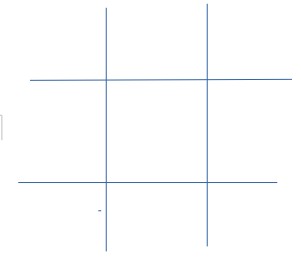
Players choose whether their symbol will be an X or a 0 and one starts by placing their symbol in a space. The second person counters by trying to get their three in a row but the person starting has an advantage so the second person may find themselves blocking the possibility of three in a row for the other. Someone may win or it may be a draw where no one can get three in a row in the nine spaces. Players take turns to start.
This game is well known to many who have played it in childhood but it is not known in some cultures. So you can get participants in a workshop to pair off and play a few games ‘normally’ until everyone feels familiar with it – and even those who know it may not have played it for years. Ensure people have paper and writing implements.
Then get the pairs to have a few games where one person starts each time but gets two goes before the other person has a go. After a few games swap around the person who has two goes at the start.
This is an exploration of built in power and privilege. If you have two goes at the start it is very difficult to lose and very difficult for your opponent to win though it may still be a draw.
At the end of a few games like this, allow people to share on how it felt having two goes at the start – or your opponent doing so. It is a very simple illustration of built in bias in a system. You can invite the sharing of comparisons in participants’ lives and in society if you wish to take it further and have the time to do so.
There is plenty of further information about the game online but the ‘power tweak’ of two goes for the person starting is definitely not part of the game as normally played.